
Sea poison tree, fish poison tree, putat laut · Lecythidaceae · Evergreen tree
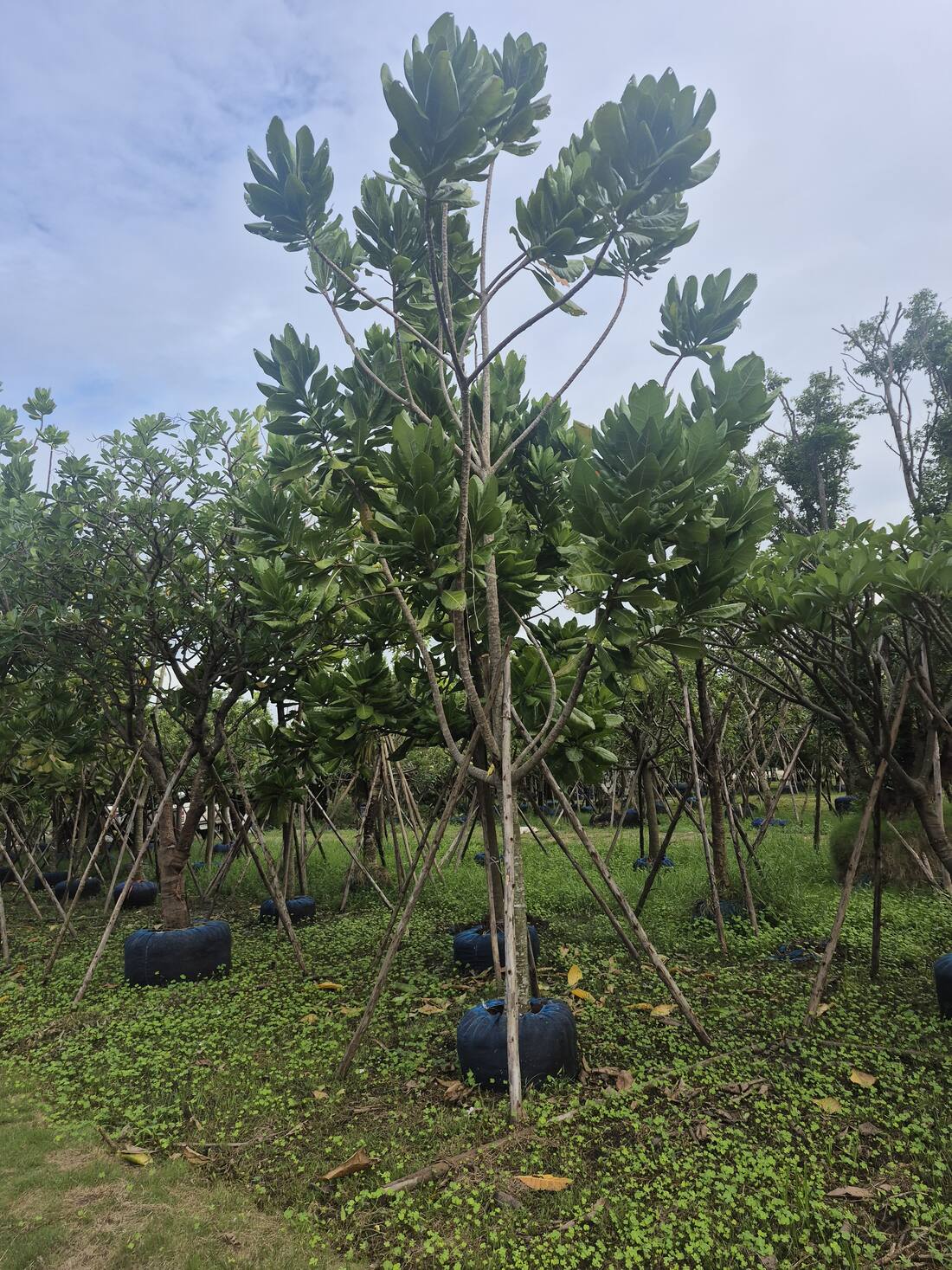
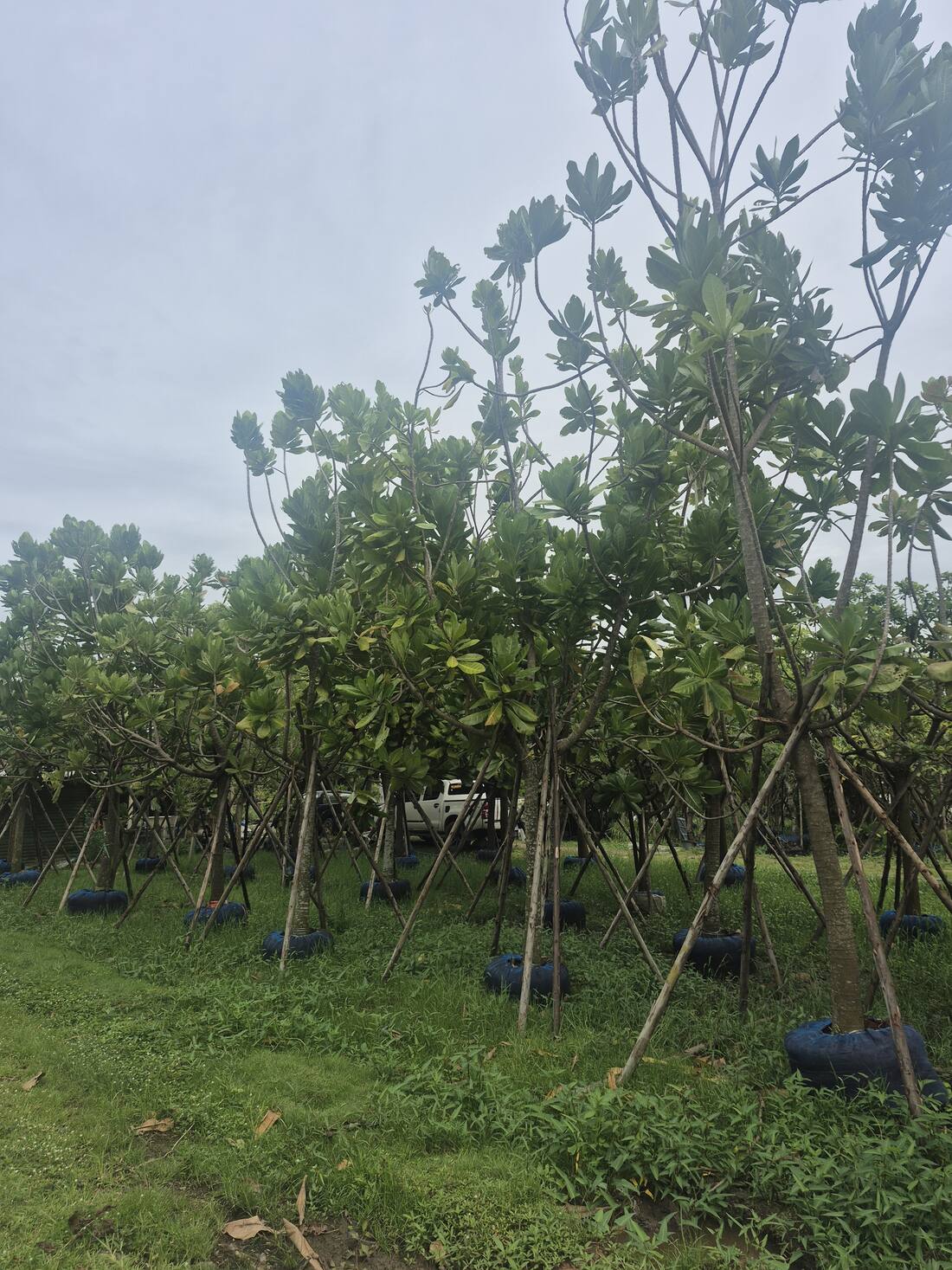
The front-line beach tree of the Indo-Pacific, and in Thailand a native of the strand — จิกทะเล, chik thale. Large leathery leaves carried in rosettes at the branch ends, dense shade beneath, and white powder-puff flowers the width of a hand that open at dusk and are finished by morning. Specify it where the planting meets the sea and salt spray would take almost anything else in this catalogue.
Specification
| Mature height | 10–15 m in cultivation; 20–25 m on wild littoral sites |
| Crown spread | 8–12 m (indicative) |
| Caliper range supplied | 5–22 cm standard, measured 1 m above soil level. Larger by arrangement. |
| Root-ball diameter | 60–120 cm (indicative) |
| Growth rate | Moderate |
| Habit | Evergreen |
| Leaf | Obovate, glossy and leathery, to 400 mm long |
| Flowering | White powder-puff, about 150 mm across, opening at dusk and shed by morning. Near year-round. |
| Fruit | Four-angled and woody, 90–110 mm, buoyant and sea-dispersed |
Landscape use
Beachfront and resort shoreline planting, seaside avenues, and shelter belts where a windbreak has to stand in salt air. It is one of the few trees that will hold a line directly on sand within reach of spray, and the dense crown gives genuine midday shade — which is why it is planted along the sea across Southeast Asia and northern Australia, where Cairns alone carries close to a hundred in its streets and parks.
Two things to settle before you specify it. It litters heavily: each flower lasts one night and drops its mass of filaments by morning, the leaves are 400 mm long, and a mature tree sets somewhere between 500 and 2,000 woody fruits a year, each about the size of a small coconut. That is a real maintenance load over paving, pool decks and parking, and a hazard beneath a tall specimen. And the fruit and seed carry saponins — the traditional use of the crushed fruit is to stun fish — so it is the wrong tree where children collect what falls. On open sand, lawn and shoreline planting, neither objection applies.
Where it works, and where it does not
Specify it for humid tropical coasts — the Maldives, the Andaman and Gulf of Thailand shores, Southeast Asia, and the resort islands of the Indian Ocean and western Pacific. FAO’s survey of the trees and shrubs of the Maldives records it, and it is a natural fit for island resort work where the planting runs down to the beach. For a scheme of that kind, our plants for Maldives resort landscaping sorts the wider palette by exposure zone.
Do not specify it for the Arabian Gulf. Its documented climate envelope runs to annual highs of about 35 °C in moderate to high humidity; Gulf summers sit some fifteen degrees above that, in air far drier than anything in its natural range. Irrigation answers the water, not the heat. We would rather say so here than load a container that dies in its first summer — if you are planting a saline coastal site in the Gulf, ask us what does work there instead.
Site tolerance
| Salinity | High — direct beachfront exposure, salt spray and saline soil |
| Wind | High — planted as a coastal windbreak |
| Waterlogging | High — tolerates brackish and seasonal tidal inundation |
| Drought | Moderate once established. Not an arid-zone tree. |
| Soil | Free-draining sand, coral sand and limestone. pH 6.0–8.5. |
| Aspect | Full sun |
| Climate | Humid tropical coasts. Annual lows 19–25 °C, highs 28–35 °C. Frost-intolerant. |
Export notes
Supplied root-balled and wrapped. The leaves are large and transpire heavily, so crown reduction before lifting is normal in this species and the tree ships with its canopy cut back — it rebuilds quickly once planted and watered in. Phytosanitary certification accompanies every shipment. See exporting plants from Thailand, and how the root ball is built, wrapped and loaded for the container on our nursery site.
Gallery
For available sizes and current stock in this species, message us on WhatsApp at +66 93 425 9892 or email contact@thaibotanic.com — or browse the species catalogue. This is one of the species we grow and supply regularly. If you are working to a programme, send the planting schedule and we will plan lifting and shipping around it. Where a design calls for something outside our usual range, we source it through the nursery network we have worked with for years, given reasonable notice.
Supply grades
| Grade | Overall height | Clear trunk | Spread | Caliper (min) | Grown in | Root ball |
|---|---|---|---|---|---|---|
| Small | 1500 mm | 1000 mm | 750 mm | 30 mm | 25 L | 100% coco peat |
| Medium | 3000 mm | 1500 mm | 1500 mm | 60 mm | 150 L | 100% coco peat |
| Large | 5000 mm | 2500 mm | 2500 mm | 120 mm | 300 L | 30% cleaned soil / 70% coco peat |
| Extra large | 6000 mm | 2500 mm | 3500 mm | 150 mm | 1000 L | 30% cleaned soil / 70% coco peat |